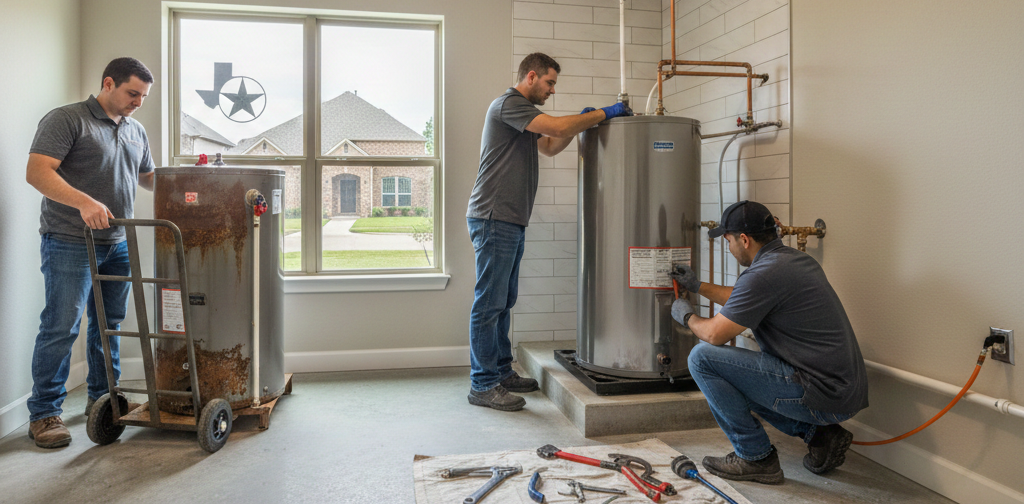

Your water heater has one job, and there are two very different ways to do it. One keeps a reservoir hot around the clock. The other makes hot water only at the moment you ask for it.
Neither approach wins outright. The better choice depends on how many people shower before work, where the unit lives, what your gas line can carry, and how long you plan to stay.
Below is a plain comparison of both systems as they perform in North Texas homes, where hard water and cold January supply lines affect the answer. By the end you should know which column you belong in.
How a Storage Tank Heater Works
A conventional heater holds 40 to 80 gallons and keeps it at your thermostat setting all day. When you open a hot tap, water leaves the top of the tank and cold water enters the bottom through a dip tube.
That design is simple and forgiving. Parts are inexpensive, service is quick, and replacement is straightforward because the footprint has not changed much in decades.
The weakness is the reservoir. Once you drain it you wait for recovery, and the tank sheds heat to the surrounding air around the clock.
How a Tankless Heater Works
A tankless unit sits idle until a flow sensor detects water moving. The burner fires at high output and heats water as it passes through a heat exchanger, shutting off the moment you close the tap.
Nothing is stored, so there is no standby loss and no tank to rupture in your attic. The unit is wall-mounted and roughly the size of a carry-on suitcase.
The catch is that a tankless heater is limited by flow, not volume. It runs all day, but only up to a certain number of gallons per minute at a given temperature rise.
Side-by-Side Comparison
Factor | Storage tank | Tankless |
Hot water supply | Finite, then recovery wait | Continuous within its flow rating |
Upfront investment | Lower | Notably higher |
Operating cost | Standby loss year-round | No standby loss, higher efficiency |
Typical lifespan | 8 to 12 years | 15 to 20 years with service |
Space needed | Floor footprint plus clearances | Wall space only |
Venting | Standard flue or power vent | Sealed stainless or PVC direct vent |
Gas demand | Modest burner input | Very high burner input |
Maintenance | Annual flush | Annual descale, filter cleaning |
Failure mode | Can leak and flood | Shuts down, rarely floods |
Our full comparison breakdown goes deeper on the technical differences.
Endless Hot Water Versus Recovery Time
The phrase “endless hot water” is accurate but often misread. A tankless unit never runs out, yet it falls behind if you ask for more gallons per minute than it can heat.
Tanks work the opposite way. They deliver strong flow to several fixtures at once, then run dry and need recovery time. A gas tank recovers faster than an electric one of the same size, which matters in winter.
Cold incoming water is the variable people forget. Denton area supply lines run near 75 degrees in August and closer to 50 in January, so every heater works harder in cold months.
Sizing by Flow Rate, Not Gallons
Tankless sizing is arithmetic. Add up the fixtures you expect to run at the same time, then confirm the unit can supply that flow at winter temperature rise.
Approximate flow demands look like this:
- Shower head: 1.5 to 2.5 gallons per minute
- Kitchen faucet: 1.5 to 2.2 gallons per minute
- Bathroom faucet: 0.5 to 1.5 gallons per minute
- Dishwasher: 1 to 2 gallons per minute
- Clothes washer: 2 to 3 gallons per minute
Two showers plus a sink can reach 5 gallons per minute. In July a mid-size tankless handles that easily. In January, with a 70-degree rise to make up, the same unit delivers meaningfully less, which is why sizing here uses winter numbers.
Tanks are sized by first-hour rating, meaning how much hot water the unit delivers during a busy morning. Either way, a unit sized wrong for the house produces complaints no repair can fix.
Space, Venting, and Gas Supply
Physical requirements often decide the question before preference does.
Footprint. A 50-gallon tank occupies about two feet of floor diameter plus service clearance. Tankless units mount on a wall, freeing the closet floor.
Venting. Tankless heaters cannot share an old atmospheric flue. They need sealed direct venting, usually stainless or PVC for condensing models, terminating through a wall or roof.
Gas capacity. This one surprises people. A tank burner might draw 40,000 BTU while a whole-house tankless draws 150,000 to 199,000. Existing half-inch piping often cannot feed that, so gas line work is a normal part of a conversion.
Electric tankless. Whole-house electric models exist, but their amperage makes them impractical in most existing North Texas homes without a service upgrade.
Lifespan and Hard Water Maintenance
Water in this region carries significant dissolved calcium and magnesium. Scale is the primary enemy of both systems, and it behaves differently in each.
In a tank, minerals settle and form a sediment layer that insulates water from the burner. You hear it as popping or rumbling, and it shortens tank life. An annual flush slows that.
Scale in a tankless unit coats the narrow passages of the heat exchanger and restricts flow. Skipping service brings error codes, reduced output, and eventually exchanger damage. Plan on annual tankless service here, not every third year like softer-water regions.
A softener extends the life of either system and is worth pricing alongside the heater.
Which Household Fits Which
A tank usually makes sense if you have one or two bathrooms, your household showers at staggered times, you may sell within five years, your budget favors lower upfront cost, or your venting and gas are already tank-ready.
Tankless usually makes sense if you frequently run out of hot water, you run multiple fixtures simultaneously, you plan to stay in the home long term, you want the floor space back, or you are already facing venting and gas upgrades.
Cost is the other half of the decision. See what installation runs in Denton for current ranges before committing either direction.
When to Call a Pro
Homeowners can safely read the data plate, time how long hot water lasts on a normal morning, and measure the available space. Flushing a tank is also within reach if you are comfortable with a hose and a shutoff valve.
Sizing, venting, and gas piping are not DIY territory. Undersized gas lines cause incomplete combustion, and improper venting can push carbon monoxide into living space. Texas requires licensed plumbers for this work, and manufacturers void warranties on self-installed units.
Should you ever smell gas near either appliance, leave the house immediately, then call 911 and your gas provider from a safe distance. Handle that before contacting any plumbing company.
Frequently Asked Questions
Does a tankless water heater really never run out of hot water?
It will not run out of volume, but it is limited by flow. If your household demands more gallons per minute than the unit can heat, the water arrives lukewarm rather than stopping. Correct sizing for winter conditions is what makes the endless supply feel endless.
How long does a tankless water heater last compared to a tank?
Tankless units commonly last 15 to 20 years, while storage tanks average 8 to 12. That gap only holds if the tankless unit is descaled annually. Neglected in hard water, a heat exchanger can fail well before the tank it replaced would have.
Can I switch from a tank to tankless without other work?
Rarely. Most conversions need new venting, a larger gas line, a dedicated condensate drain for condensing models, and sometimes a nearby outlet for the control board. A technician confirms exactly what your home requires during an on-site evaluation. The scope depends on your existing setup and the unit you choose.
Is tankless a good idea with North Texas hard water?
Yes, with a maintenance commitment. Annual descaling keeps the heat exchanger clear, and pairing the unit with a softener extends its life considerably. Scale builds faster here than in most parts of the country. Homeowners unwilling to schedule that service are usually better served by a tank.
Which one saves more on utility bills?
Tankless units avoid standby heat loss and generally use less energy overall, though savings depend on how much hot water your household uses. Light users see modest savings. Heavy users see more. Payback timelines stretch longer when a conversion requires extensive gas or venting work.
Talk It Through With a Local Plumber
Choosing between these two systems is easier when someone has looked at your gas supply, your venting path, and your family’s morning routine. Rite NOW AC, Heating & Plumbing installs both across Denton, Flower Mound, Highland Village, Aubrey, Corinth, and the surrounding North Texas communities. Call (940) 213-1989 and we will walk your options honestly, including the one that costs us less.