
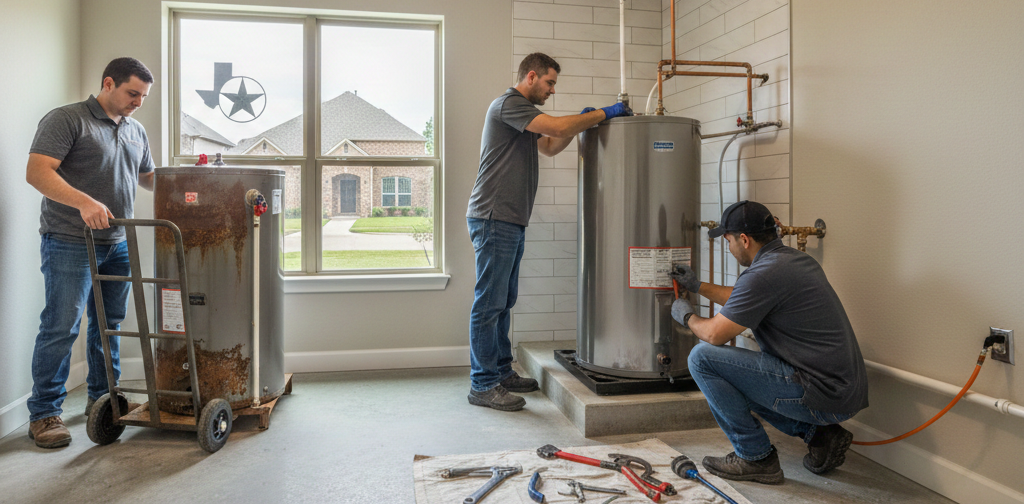
Water heaters rarely quit without warning. They complain for months first, and most homeowners are too busy to notice until the shower goes cold on a 28-degree morning.
Fall is the honest deadline. A tank that limped through a mild North Texas summer can hit its limit the first week temperatures drop, because cold weather makes the appliance work harder.
Here are seven symptoms worth taking seriously, plus a way to tell which problems a technician can fix and which mean the unit is finished. Read them while you still have the luxury of scheduling on your own terms.
Why Cold Weather Exposes a Weak Tank
Groundwater temperature drives everything. In a Denton summer, water entering your heater is already warm. In January it arrives near 50 degrees, so the burner or elements must add far more heat to reach the same setpoint.
That means longer run cycles, slower recovery between showers, and more stress on a tank that is already thinning. A tank with much of its capacity buried under sediment gets away with it in August and cannot keep up in January.
Location adds to the problem. Many heaters here sit in unconditioned garages or attics, where a hard freeze like February 2021 or January 2024 drops temperatures well below what anyone designed for. Plumbers are booked solid during those events, so a failure at the wrong moment means days without hot water.
Signs Your Tank Is Wearing Out
1. The unit is past 8 to 12 years old
Storage tanks have a working life, and most reach it between year eight and year twelve. Hard water shortens that window.
Check the serial number on the data plate. Most manufacturers encode the build date in the first four characters, usually a month and year. If the math puts you past a decade, start planning.
2. Hot water looks rusty or tastes metallic
Fill a glass from a hot tap. Discoloration or a coppery taste on the hot side alone points to corrosion inside the tank.
Every tank has a sacrificial anode rod that corrodes so the steel liner does not. Once the rod is consumed, the liner rusts through. On a young heater an anode swap buys years. On an older one, rust usually means the tank is going.
3. You hear rumbling or popping
Those noises are water boiling underneath hardened mineral deposits. Calcium settles out of our water supply and bakes onto the bottom of the tank, insulating the steel from the burner.
A yearly flush prevents most of this buildup. If a heater has never been flushed and now sounds like popcorn every evening, the sediment has likely hardened past the point flushing helps.
4. Hot water runs out sooner than it used to
Nobody’s habits changed, but the second shower is now cold. That is capacity loss, and sediment is usually the reason: space occupied by minerals no longer holds hot water.
Failed heating elements cause the same complaint in electric units, as does a broken dip tube dumping cold water at the top of the tank. Those are repairs. Sediment in a decade-old tank generally is not.
Signs of Failure Already Underway
5. There is moisture or rust at the base
Look at the floor around the heater, then at the bottom seam. Damp spots, mineral crust, or flaking rust are serious.
Small leaks do not seal themselves. Steel tanks fail from the inside out, and a weeping seam is the last stage before a rupture that empties 50 gallons into the attic or garage.
6. The T&P valve leaks or weeps
The temperature and pressure relief valve opens if the tank exceeds safe limits. A valve that drips may simply be worn, or your home’s water pressure may be too high.
Either cause needs attention quickly. Never cap the discharge line. That valve is all that stands between a malfunctioning heater and a real explosion risk, and blocking it is among the most dangerous shortcuts in plumbing.
7. You keep paying for repairs
One repair on an eight-year-old heater is reasonable. Three service calls in eighteen months is a pattern, and that money would be better spent on a replacement.
A useful rule: when the repair estimate nears half the cost of a new unit and the heater is past year eight, replacing wins. Our overview of more replacement warning signs covers where that line sits.
Repairable Problems Versus Terminal Ones
Not every symptom is fatal. The table sorts the common ones.
What you notice | Likely cause | Verdict |
No hot water, electric unit | Burned-out element or thermostat | Repairable |
Pilot will not stay lit | Thermocouple or gas control valve | Usually repairable |
Lukewarm water on a newer tank | Broken dip tube | Repairable |
Popping and rumbling | Sediment layer | Flush first; replace if old |
Rust only in hot water | Anode rod spent, liner corroding | Replace if past year eight |
Puddle or damp seam at the base | Tank wall failure | Replace |
T&P valve dripping | High pressure or failed valve | Repairable, verify pressure |
Repeated failures on an aging unit | Cumulative wear | Replace |
If your symptom lands in the repairable column, a service call is the right next step and the cheaper one.
What a Technician Checks Before Calling It
A good diagnosis is not a glance at the birth date. Expect a technician to test water pressure, inspect the anode rod, check thermostat calibration, examine flue draft on gas units, test element resistance on electric units, and inspect the tank base for corrosion.
The flue inspection matters most for safety. A corroded or disconnected vent on a gas heater can spill combustion gases into your home, and carbon monoxide has no smell. If your CO alarm sounds, get everyone outside and call 911 before anything else.
Planning the Swap on Your Schedule
Replacing on purpose costs less than replacing in a panic. You compare equipment, decide between tank and tankless, and avoid after-hours rates.
Timing matters too. Late September through early November is when plumbing schedules are open here, before the first cold front sends everyone searching at once. Reviewing what a new unit runs in Denton ahead of time takes the sting out of it.
When to Call a Pro
Several checks here are safe to do yourself. Filling a glass from a hot tap, listening for noise, looking for moisture, and reading the data plate take no tools and no risk.
Draining a tank is manageable if you are careful with hot water and know where your shutoff is. Beyond that, stop. Gas connections, venting, T&P valve replacement, and 240-volt wiring belong to a licensed plumber, both for safety and because Texas requires it.
If you smell rotten eggs or gas near the heater, leave the house first, then call 911 and your gas utility from outside. When a tank is flooding, shut off the water supply if you can reach the valve safely and request emergency plumbing help.
Frequently Asked Questions
How long should a water heater last in North Texas?
Most storage tanks run 8 to 12 years here, and hard water pushes many toward the lower end. Annual flushing and a replaced anode rod extend that meaningfully. Tankless units last longer, often 15 to 20 years, provided they are descaled once a year.
Is rusty hot water always a sign I need a new heater?
Not always, but usually. If only the hot side is discolored and the unit is under six years old, a spent anode rod may be the cause and replacing it can help. Rusty water from an older tank almost always means the liner is corroding through.
Can sediment buildup be fixed without replacing the heater?
Sometimes. A flush removes loose sediment and restores capacity on a tank that has been maintained reasonably well. Once deposits harden into a crust on the tank bottom, flushing accomplishes little, and the efficiency you lost does not come back.
Should I replace my water heater before it fails completely?
If it shows two or more of the signs above and is past year eight, yes. A planned replacement avoids water damage, emergency pricing, and cold showers during a freeze. You also get time to choose the right size and fuel type instead of accepting whatever is available.
What happens if my water heater fails during a hard freeze?
You lose hot water when you need it most, and demand for plumbers spikes across the region. Response times stretch from hours to days. A tank that ruptures in an unheated attic can also cause water damage on top of everything else.
Schedule a Check Before the First Cold Front
If your heater is showing these symptoms, Rite NOW AC, Heating & Plumbing will tell you honestly whether it needs repair or replacement. We serve Denton, Sanger, Aubrey, Argyle, Double Oak, Crossroads, and neighboring North Texas towns. Call (940) 213-1989 to get on the schedule while there is still room.

