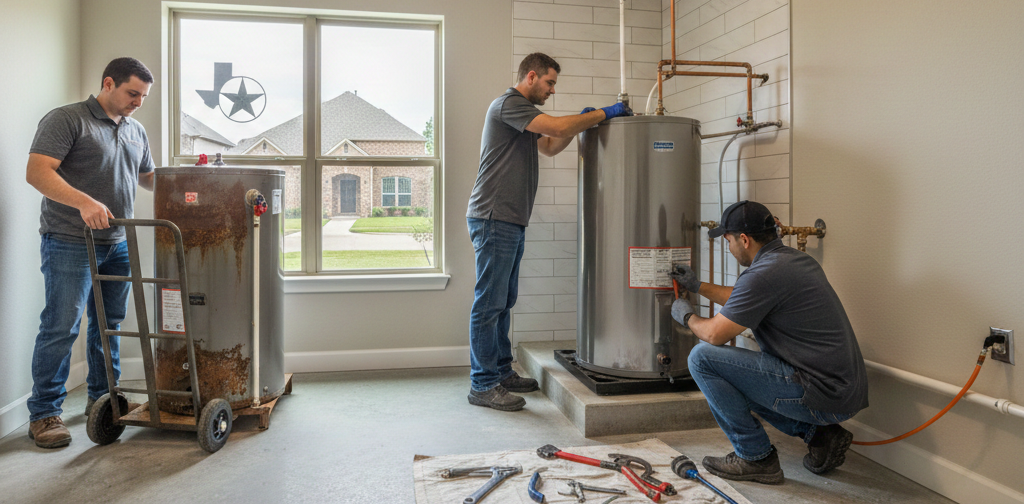

Almost nobody plans for a water heater. The tank works quietly in a closet or attic for a decade, then one morning the showers run cold and you are pricing a purchase you have never made before.
That puts you at a disadvantage. Quotes vary widely between companies, and the reason usually is not markup. Two houses on the same street can need different venting, different code updates, and different labor to pull the old unit out.
This guide lays out approximate installed ranges for Denton and nearby North Texas towns, then walks through the variables that move your number. Ranges here are typical, not promises. A real price requires someone standing in front of your unit.
Typical Installed Price Ranges by Type
The figures below reflect what North Texas homeowners commonly see for a standard swap, including unit, labor, basic materials, and normal code items. Premium brands, difficult access, and heavy code corrections land at the upper end or above it.
Water heater type | Typical installed range | What you are paying for |
40-gallon gas (atmospheric vent) | $1,600 to $2,600 | Lowest cost when venting and gas supply already meet code |
50-gallon gas | $1,800 to $3,000 | Extra capacity, similar labor to a 40 |
40-gallon electric | $1,400 to $2,300 | Simpler install, no combustion venting |
50-gallon electric | $1,500 to $2,500 | Slower recovery than gas |
Gas tankless | $3,500 to $6,500 | New stainless venting, gas line work, condensate handling |
Hybrid heat pump (50 to 65 gal) | $2,800 to $4,800 | Condensate drain plus space and air-volume requirements |
Treat these as a planning window. Your written estimate is the only number that counts.
Fuel Type Sets the Baseline
Electric units cost less to buy and less to install because there is no combustion air, no flue, and no gas connection to verify. The trade-off shows up on the utility bill and in recovery speed.
Gas units cost more upfront but heat water faster, which matters in January when incoming city water arrives much colder than it does in July. If you are weighing the two, our breakdown of how gas and electric models compare covers the operating-cost side in detail.
Switching fuel types is where budgets break. Electric to gas means new gas piping and venting. Gas to electric means a dedicated 240-volt circuit and possibly panel capacity you do not have.
Code Items That Appear on Nearly Every Quote
Texas code and local inspection requirements have tightened over the years. A heater installed in 2009 may be missing several things that are mandatory today, and a licensed installer cannot legally leave them out.
- Thermal expansion tank: Required on closed systems with a backflow preventer or pressure-reducing valve. Roughly $150 to $350 installed.
- Drain pan and drain line: Mandatory for attic and interior installations. Expect $150 to $400 depending on where the line terminates.
- T&P discharge piping: The temperature and pressure relief line must run to an approved location. Often included, sometimes broken out.
- Permit and inspection: Commonly $75 to $250 in this area. Pulling one protects your homeowners coverage and your resale paperwork.
- Haul-away and disposal: Usually $50 to $150 for the old tank.
None of these are upsells. If a bid is dramatically cheaper than the others, check whether these line items are simply missing.
Where the Unit Sits Changes the Labor
Location is one of the biggest hidden drivers of cost in North Texas homes.
Garage
The easiest scenario. Open access, a floor drain or nearby exterior wall, and room to maneuver. Garage installs typically sit at the low end of the range.
Attic
Very common here, and considerably more work. A technician has to carry a drained tank down a pull-down ladder and bring the new one up while protecting your ceiling. Attic jobs also need a pan, a routed drain, and sometimes platform repair. Add several hundred dollars.
Interior closet or utility room
Tight clearances, doorways narrower than the tank, and flooring to protect. Combustion air requirements for gas units in closets can force venting changes that a garage install would never need.
Upgrades That Move the Number
Some homes need work beyond the swap. These items turn a $2,000 job into a $4,000 one.
Venting changes. Going from an older atmospheric-vent tank to a power-vent or tankless unit means new vent material and a new termination point through a wall or roof. Budget $300 to $1,200.
Gas line sizing. A 40,000 BTU tank and a 199,000 BTU tankless are not comparable loads. Undersized supply piping starves the burner. Correcting it commonly runs $400 to $1,500 depending on the run length.
Electrical capacity. Hybrid and electric units need a dedicated circuit at the right amperage. New wiring from a full panel can add $500 to $1,800.
Water quality work. Denton area water is hard, and scale shortens the life of any heater. Some homeowners pair a replacement with a water filtration system to protect the investment.
How to Read a Quote Without Guessing
Ask for the estimate in writing, itemized. A quote worth trusting names the brand and model number, the capacity, the recovery rating, the warranty length on both tank and labor, whether a permit is included, and what happens if the technician finds a problem inside the wall.
Compare warranties carefully. A six-year tank and a twelve-year tank can look nearly identical on the shelf while differing in anode rod quality and insulation.
Watch for vague language. “Miscellaneous materials” as a single large line is worth a question. Reputable companies explain their charges without getting defensive.
Financing and Timing the Purchase
A failed heater rarely arrives at a convenient moment. Financing is available through Rite NOW, which lets you choose the right unit instead of the cheapest one on the truck that day.
Planning ahead helps most. When you replace a water heater on your own schedule, you can compare bids and avoid emergency rates. Homeowners who wait for a rupture pay for water damage on top of the heater.
When to Call a Pro
Draining a tank, testing the T&P valve, and checking for moisture are reasonable homeowner tasks. Everything past that point is not.
Gas connections, venting, and combustion air affect carbon monoxide risk directly, and 240-volt work carries shock and fire risk. Both require licensing in Texas, and a DIY install can void your manufacturer warranty.
If you ever smell gas or a rotten-egg odor near the unit, get everyone outside before doing anything else, then call 911 and the gas company from a neighbor’s driveway. Do not flip switches, and do not call a contractor until the leak is cleared. For everything else, professional water heater installation is the safe path.
Frequently Asked Questions
How much does it cost to replace a 50-gallon water heater in Denton?
Most 50-gallon replacements in the Denton area fall between $1,500 and $3,000 installed, with gas units running higher than electric. Attic location, a required expansion tank, venting corrections, and permit fees push the total upward. An in-home evaluation is the only way to get an accurate figure.
Is a tankless water heater worth the higher price?
It can be, especially for larger households that run out of hot water. Tankless units last longer and cut standby energy loss, but the upfront cost is roughly double and North Texas hard water makes annual descaling necessary. Our tankless installation page explains what the conversion involves.
Do I need a permit to replace a water heater in Texas?
Yes. Water heater replacement is a permitted job in Denton and neighboring cities, and the work must be performed by a licensed plumber. The permit covers inspection of venting, gas or electrical connections, and required safety devices. Skipping it can create problems at resale.
Why did my quote include an expansion tank I did not have before?
Homes with a pressure-reducing valve or backflow preventer form a closed system, and code requires thermal expansion control. Your old heater likely predates that requirement locally. The tank absorbs pressure spikes as water heats, protecting the new unit and your plumbing.
How long does the installation take?
A straightforward tank-for-tank swap usually takes two to four hours from shutoff to first hot water. Attic installations, fuel conversions, and tankless retrofits run longer, sometimes a full day. Venting changes and gas line modifications add the most time, and permit inspection may happen separately.
Get a Straight Number for Your Home
Rite NOW AC, Heating & Plumbing has served North Texas for more than 40 years, and we quote water heater replacements in Denton, Corinth, Argyle, Sanger, Lake Dallas, and nearby communities. Call (940) 213-1989 to schedule a visit, and you will get a look at your setup, an explanation of what the home needs, and a price in writing before work starts.